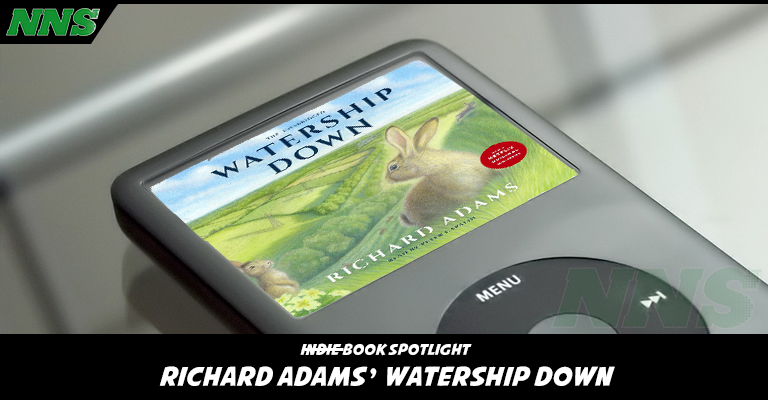
Hey there, Readers. Dropping another classic bit of literature on your To Read pile today! Recently, on a whim, I decided to pick up this little beauty again and I enjoyed it so much, I figured I might want to share it with you. If you’ve already read this one, you know how great it is. If you haven’t – which is valid, I’ll get into why in a moment – I’m here to re-reccomend it to you.
Watership Down fits into a weird place in terms of genre. Oftentimes, animal stories are deemed the realm of children; Pooh Bear, Peter Rabbit (Actually, Beatrix Potter’s entire publication list.), Charlotte’s Web and Babe the Pig – all these would be termed middle grade fiction at their most mature and dismissed by most adult readers as a bit juvenile. Looking at the cover of Watership, you’d be forgiven for insisting it probably fits in there somewhere. Rabbits are soft, cuddly little guys and clearly a story about them is a story meant for kids. This is a mistake that has traumatized many children as the animated adaptation of Watership Down used to find its way into otherwise very kid-friendly Easter displays back in the days when you used to have to rent movies from a physical store. I’m sure the same thing has happened with the book. This is not a story about happy little animal friends doing cute little animal friend stuff. It’s a tale of a long journey from a dangerous situation to a new home and the fight to hold on to land. Territorial wars, the cruelty of man and beast alike, death, reproduction and the fight against contentment at too high a cost. It features a rich mythology and even a unique language for words that only rabbits need.
Because of this juxtaposition, it struggled to find a publisher initially. It was deemed too babyish in appearance because rabbits are cute and older readers would dismiss it for this reason, but if a younger reader picked it up, they’d probably find it upsetting due to the nature of the story. Humans are, especially, painted in a horrific light by this book. (Don’t worry. We’ve earned it. You know we have.) There’s a Forward written by the author for this version of the book that explains this in more detail and it’s a fascinating bit of literary history.
Anyway! I’m here to tell you that if a cute, cozy book about fluffy bunnies isn’t your particular cup of tea… good. You won’t find one here.
Book Stats
- Author: Richard Adams.
Formats: Hardcover, Paperback, Kindle, and Audible.
Price: $21.81 for Hardcover, $11.26 for Paperback, $10.99 for Kindle, and $21.58 for Audible, or one Credit on Audible.
Length: 480 pages or 17 hours 31 minutes in audio format.
Narrator: Peter Capaldi.
Number of books in the series: Two, with a sequel to this novel being a collection of short stories
centered around the rabbits of Watership Down.
Basic Premise
Hazel and Fiver have always been together. They’re not brothers, but might as well be. The issue with Fiver (Named that because he was fifth in a litter of five and therefore the runt.) is that he has a bit of the ol’ precognition. He receives visions that, generally, come true despite being cryptic and hard to decipher. One day he has a vision of death approaching their warren and it’s the most catastrophically unnerving vision he’s ever had.
They take it to the head rabbit for their warren and lay it out that it might be a good idea to move along. Unfortunately, the old head rabbit is completely unwilling to do so and sends them on their way. They manage to grab up a few rabbits who are willing to pick up their lives and shift elsewhere, but not nearly the full warren.
As this group of rabbits moves, they run into many dangers. Badgers, foxes, and even a warren of rabbits who have an unhealthy relationship with farmers. They meet a seagull and a mouse, both of whom they befriend at Hazel’s suggestion as new chief rabbit, and they meet cats and dogs, none of which they have a positive reaction to. We get to enjoy the differing personalities of the many and varied rabbits from the Sandleford warren; Bigwig, a rough and tumble bruiser. Dandelion, a wonderful storyteller. Pipkin, another small, runtish rabbit with a heart full of bravery among many others. Each has their own strengths and part to play in getting all of these lapines to their destined home, the titular Watership Down.
Their final challenge is a much larger, very different warren of rabbits not too far from the new home they’re building for themselves. The problem they’ve run into is that they only managed to bring male rabbits with them and they have absolutely no ladies with which to make future generations for their new warren. They approach this other rabbit city, hoping to foster kinship and bring with them some does.
It doesn’t go well.
The leader of the opposing warren, General Woundwort, is an authoritarian, paranoid and violent creature who will have no-one leave his warren and who does not want to give even an inch to this new group of rabbits. Woundwort is a killer, and he has his sights set on the rabbits of Watership Down after they manage to pull off a great heist in which they grab a bunch of does for themselves, saving them from a life of misery at Woundwort’s paws.
Will all of our lagamorph heroes survive? Will Watership Down turn into a fully realized warren… or will it wind up a tunneled out tomb for our adventurers? You’ll need to read it to find out!
My Take
This is such a fantastic book. As I said in the preamble, it struggles to this day in terms of genre and market but I’d say less so now than it might have in the past, as I think children of this era are exposed to more violent content in many ways and there’s also less pressure to not appear babyish or immature. An older child could easily and happily grab up a copy of Watership Down without wondering if someone will pick on him for reading the book about bunnies. A younger kid might pick it up and find the more intense scenes tame compared to your average episode of whatever shonen anime is hot at the moment. I also believe Watership Down walked so series like Erin Hunter’s Warrior Cats could run. (That’s just one of the more popular examples, but I could also cite Gary Kilworth’s Foxes of Firstdark and Kenneth Oppel’s Silverwing books.)
Watership Down was published in 1972 and that was after some time of being rejected by publishing houses so it was probably written, mostly, in the late sixties. It’s set in a contemporary era with cars and trains, humans who smoke and shoot at rabbits with shotguns and divide the countryside up with fences, walls and hedges. (Even the rabbit mythology, told as if to evoke a mystical past like that of the Iliad or epic of Gilgamesh features these things. It’s a tradition of oral history that is probably edited consistently generation to generation to include new elements while keeping the core of the stories intact.) The places mentioned are all real – Richard Adams took great pains to describe and map the route the rabbits take from their home warren (Which gets bulldozed to make way for a building.) and Watership Down. These are all places you can (Or probably more correctly, could) go in Hampshire, England. I love that level of attention to detail. I also love that this started as a story he was making up for his daughters during long car rides through the countryside. They bugged him to actually write it down and he did just that, submitting it to publishers without revision or editorial process until it was taken on.
The narrator for the audio version is Peter Capaldi and he does an absolutely amazing job. Each rabbit is distinct from the others and he uses a massive range of tone shifts, cadence switches and accents to achieve this. Not surprising that he’d be amazing as he’s also the 12th Doctor in Doctor Who, among many other things.
All in all, if you’re looking for a bit of classic literature to add to your pile for the summer, or have a youngster who is looking for a good book to sink their teeth into, I can scarcely think of a better one to offer up!
Facebook Comments