In a world where the larger studios get bigger and bigger, it becomes harder for independent and small scale productions to make their mark in the industry. Legion M, the first fan founded film company, wants to help find the jewels hidden within the world of indie films and help them shine above others.
To achieve this goal, Legion M has found some interesting ways to create their shareholders, utilize Film Scout programs to select films from larger festivals, and bring them to Legion M’s attention.
Originally Legion M launched micro-investments, specifically for You Can Call Me Bill and My Dead Friend Zoe, then they changed their model for Fackham Hall. Their new model created the ability to allow fans to be able to invest into the new Film Fund, which allows fans to invest as low as $100 into the Film Fund, which specifically is set for a specific film.
This brand new way gives fans of Legion M a new way to connect with the Film Industry, but also the ability to fill a space that normally is left only to Hollywood elites!
The plan is for the Film Fund to help Legion M pool money from the community of investors and use it to support films in the form of funds for marketing, funds to help develop and plan a release strategy, as well as helping the film find an ideal audience. Legion M hopes for Film Fund investors to be able to recoup their principal, as well as a limited upside (typically capped at 10%-20%) within 12 to 18 months from the investment window.
Money within the pool will be recouped from each movie. Outside any specific choice by the Film Fund investors, the pool will automatically roll over into the next Film Fund’s Investments. The Film Fund pool from Fackham Hall can expect to have a likely 40%-50% of the initial investment rolled over into the next film for the Fund, Nimrods. Legion M hopes for the Fund’s target annual return to be between 7.5% to 15% or above.
If investors want to bow out of the fund, they can request a “cash out” to redeem their interest and withdraw their money from the fund on a quarterly basis.
To get a better idea about the fund, we talked to Jeff Annison, co-founder of Legion M to get a deeper look into the goals of Legion M’s Film Fund.
Eric Bryan Seuthe II: Thank you for taking the time to talk with us today Jeff! What inspired you to create Legion M before it’s launch in 2016?
- Jeff: It was a change to security law called the JOBS Act and it made Legion M possible. Before the JOBS Act, the only people that could invest in a new company, or a movie were as accredited investors, which is the wealthiest few percent of the population. When the laws changed. They opened it up so that anybody had the opportunity to invest in pre-IPO companies like Legion M. There’s a lot of constraints around it, it’s all regulated by the SEC, and there’s a lot of reporting that we have to do and they do bad actors checks and all that sort of stuff, but it really created the opportunity to build a movie studio that was designed from day one to be owned by fans. And so the whole idea behind Legion M. The fact is, if you’ve got a movie studio owned by a large community of fans, you can have huge competitive advantages because you’ve got a legion of people that are going to come out opening night and see your movie. You’ve got a legion of people that are going to talk about your movie online. You know, they’re going to bring their friends and their family because they are a part of it. So, basically, we saw the laws changing, laws that have been on the books since before the Great Depression, and we thought, “Oh my gosh, this is a once-in-a-lifetime opportunity, so we took advantage of a disruptive change and we jumped in headfirst and have just been hanging on ever since.
Eric Bryan Seuthe II: Do you think your work with the New York Rock Exchange was a good stepping stone, connecting the medium of music with the fans in the same kind of way?
- Jeff: 100%, Partially that was the whole reason that I was aware of the JOBS Act, and Paul Scanlan, was because of the work with the New York Rock Exchange. That was a really pivotal part as the New York Rock Exchange gave us an opportunity to really explore and understand the space a little bit. It gave us the opportunity to work with fan communities and to recognize the power that equity crowdfunding would have. The experience that we had with the New York Rock Exchange, it set the table for the whole thing.
Eric: Since your 2017 release of Colossal, Legion M has released over 15 films, with a lot of them being documentary and comedically styled. Is this a direct connection to the managing staff at Legion M influencing the films picked up, or is this driven more by the shareholders?
- Jeff: It’s more driven by the shareholders. First of all, we haven’t released all of those films. Like when we started off with Collosal, we made a small investment in that movie. Neon had bought that movie at Toronto International Film Festival. We partnered with Neon to help them release. When we started that’s what we were doing. We made a small equity investment in Mandy, we partnered with Screen Media for the release of Memory: The Origins of Alien, that some of our earlier projects. We since then have grown and leveled up over the last ten years from making small investments in other people’s products, to the point where we are completely financing, developing, producing, and releasing movies on our own. So our more current films, like the William Shatner documentary, that’s one that we completely produced, developed, financed, and released. Fackham Hall, which is our most recent release, that was a co-distribution with Blecker Street, and we partnered with them on it.
To get back to your question, at the end of the day, Paul and I report to our shareholders, we believe that not only do we have an obligation to do what the fans want, what the company wants, but it’s also a tremendous opportunity because collectively the wisdom, knowledge, and passion of our 60,000+ investors, and our hundreds and thousands of people in the community is so much greater then Paul, or I. We believe that if you look at Hollywood in general, so many of the decisions in the independent film realm are made by individuals baised gut feel and sometimes politics, and power dynamics within a team. For us, we believe that the fact that because we have this community of people that we can go to and we can ask some questions, and give them poles, and create tools like Impulse and Film Scout, that literally give them a voice in making these decisions. It’s not only the right thing to do, but it helps us make make better and smarter decisions that benefits every shareholder in the community.
Eric: So that actually brings me to my question about You Can Call Me Bill, why did you decide to pivot from the Micro-Investment strategy of that film and My Dead Friend Zoe, to the current model for the Film Fund?
- Jeff: So it’s a great question. You Can Call Me Bill, the William Shatner documentary, was the first film that we ever raised money for seperately. So when hwe started in 2016, and ever since 2016, Legion M has given people the chance to own a piece of the studio itself. We are literally selling stock in the company. It’s kinda like if you could go back in time and buy shares in Walt Disney Studio back when Walt Disney was just starting up. It’s a very high risk investment, it’s a very long term investment. We are very upfront about the risk, the fact that most small startups fail. We are a startup company in entertainment, so it’s double jeopardy. That’s what Legion M represents. Those startup companies that go on to succeed can change the world. Walt Disney faced long odds when he started, and Mark Zuckerberg when he was starting Facebook, that’s the startup proposition. It’s a big swing for the fences.
Over the years, people had asked us, “Hey what if I want to invest in an individual movie?” So, when we got to the point of produce movies ourselves, we thought “Okay, well this is an interesting thing to be able to offer to our shareholders.” Shatner was the first, My Best Friend Zoe was the second, Fade to Black is the third. In this case we are giving people the opportunity to invest directly in the film in exchange for royalties in relation to that film. Again, it’s a very high risk investment because most movies don’t make money, especially in independent films, but there are also a lot of fringe benefits, a lot of intangible or emotional ROI as we would describe it. Like having your name in the credits, coming out to the premier, or being able to say I’m part of the reason that this movie exists. I can tell you that for Shatner and Zoe, the two who have already released, so many of the investors in those films are so happy to have been a part of that, to be a part of William Shatner’s legacy. My Best Friend Zoe was an amazing movie. One of the best reviewed movie of Morgan Freeman’s career. If you were an investor in that movie, you are a part of the reason that that movie exists. Your name will be in the credits forever. Your great-great-great-grandchildren will be able to see it. There is something really cool about that.
That’s what we have done with those three movies. We don’t have any offerings that open right now, but we also recognized, as Legion M started expanding our distribution capabilities, we recognized that there’s another position that people often invest in, in Hollywood that, once again, is only available to wealthy accredited investors and had never really been opened up to fans and to the general public. That’s effectively the role of a P&A investor, or investing in the distribution of the film. It’s a fundamentally different investment type than investing in production of a film, because whereas investing in production of a film is very high risk, investing in the release of a film is generally pretty low risk. You’re putting last money in. You’ve already seen the movie, it’s already done, all of the risk associated with, “Oh, the movie went over budget,” or “Oh, the movie didn’t get done,” or “Oh, there’s production problems,” that sort of stuff, you don’t have any of that. You can literally watch the movie, and you know that it’s a good movie. You know that it’s getting distribution.
That’s another big challenge today, is that even if you produce an amazing movie, a lot of amazing movies don’t get good distribution, or any distribution at all in some cases. So, a lot of the risk of it is gone. You get to put last money in, you get the first money out. So when that movie releases, all the money that comes back to the distributor, generalizing, is used to pay back the P&A investor. So you’re literally getting first money back, and then if you don’t recoup your investment in box office, then you get it in the VOD. If you don’t recoup it in VOD, then you get it in the streaming, and it just keeps going. You basically collect every dollar until you’ve recouped your investment and gotten your return, a capped return. It’s not like Legion M, where we’re swinging for the fences and hoping to get a 10x return or a 100x return or something. You’re going to get a 15% return on your money, but it’s generally pretty secure.
And so, we recognized that this was, (A) an opportunity that regular people don’t really have access to right now, and (B) that it’s hugely strategic for Legion M to raise that money from our community and from people that want to be a part of these movies, than it is to raise it from where everybody else in Hollywood gets it, which is wealthy P&A investors.
Eric: So, another really cool thing about the film fund is that it does have the option to roll over if you don’t divest from the fund every quarter. However, recently, I did notice that on top of this Nimrods film, the next one on the list for the Film Fund was a confidential film, are those two films going to be running at the same time from two different pools from the film fund, and if so how will that work?
- Jeff: No, it’s a great question, and you’re right, you really hit two of the big features of the film funds. One is the fact that the returns from one film automatically roll over to the next. What we learned from all the people who invested in Shatner and Zoe, because both of those films have released, all of the investors in those films have gotten money back. They’re not whole, or made a profit, but they’re getting money back from those films, and they will continue to get money back from those films in perpetuity. But, a lot of people were like, “Well, shoot, is there a way to just roll this over into the next film?” So, when we set up the film fund, we explicitly set it up so that it automatically rolls over until you’re ready to cash out. The other really important feature, is that the film fund is liquid, right? You have the ability, when you’re ready, to say, “Okay, I would like to cash out. I want to redeem my interest.” Basically, you can take your money out of the film fund. Now, there are restrictions as to how that goes, especially if we’re waiting for money, the timeline on the film fund investments is generally a year or two to get your money back. As opposed to, like I said, Shatner or Zoe, when you invest in a film and you’re going to get royalties in perpetuity.
However, the confidential film was a very limited time window. So with Fackham Hall, the investment was back in time, so it was a separate investment. It’s still an investment in the Film Fund. So when it’s done, it’s still going to roll over into the next Film Fund project, but for example, with Nimrods, all of the invests in Fackham Hall, we’re projecting/expecting that about 40 or 50% of the Film Fund Fackham Hall investment will actually be back in time to roll over into Nimrods. It’s just kind of a great example of, you know, the fact that the quick returns, and even if we don’t have the entire investment back or the 15% profit on top of it, 40 to 50% is able to be already reinvested into something else. It’s a nice kind of compounding model where our goal is to just have a steady stream of projects like this and films in the Film Fund so that your money is always rolling over and we’re putting it to work as much as possible.
Eric: Legion M’s next film is Nimrods, how did Legion M decide to get involved with this film?
- Jeff: So we saw the movie at Toronto International Film Festival and loved it. It’s a fun movie, it’s got a great cast, the soundtrack is amazing, the fact that the band is involved with it is amazing. We thought that this was really our focus when it comes to film these days, and what we’re looking for: fun, crowd-pleaser movies. We’re looking for movies that you want to round up a bunch of your friends and go see in a theater today. We’re looking for movies that frankly are worth seeing in a theater. As opposed to something that’s like, “Oh yeah, that looks like a good movie, but I can just wait till it’s available on streaming,” or something like that. We felt like this one really checked all the boxes.
Eric: What is the next big thing fans of Legion M can look forward to?
- Jeff: We’re going to have a very busy August because Nimrods is coming out August 14th! Right now we’re gearing up for our next fundraising round for Legion M, so we should be announcing that pretty soon. We’re really expanding our distribution capabilities. We also just launched our “Legion M Theater Alliance” where we’re working with movie theaters to build out a network of Legion M movie theaters, and working with those theater chains to create special kind of offers and synergies for their customers and our shareholders.
That’s the stuff that’s near term, right on our radar, but we’re always looking for new projects. We’ve also got a great project in development called Defiant, but we’re hoping to have some announcements about that soon. I think if we kind of go back to the beginning of the interview and we were talking about, when the company started. If you went back and asked us in 2016, “Where do you guys think you’ll be in the future?” I think that we’ve in many ways wildly surpassed our expectations. Most startup companies fail, and we’ve outlasted a lot of companies. Like, Quibi, MoviePass, and Magic Leap, these huge companies with hundreds of millions of dollars and high level talent. They took their swing and it didn’t work out. The fact that it’s been 10 years and Legion M is still, not just alive, but thriving and growing, it’s super exciting. So we’re just looking for ways that we can continue to grow our community, our capabilities, and make cool stuff happen.
Eric: Thank you once again for your time!
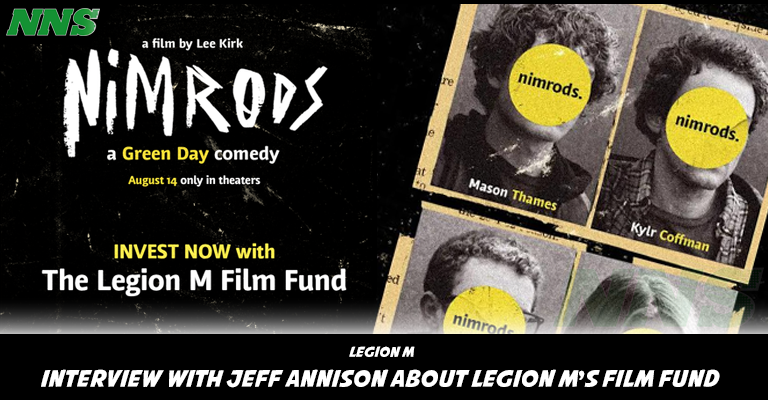
The recent project, as mentioned above and in the interview, is Nimrods.
Nimrods is a coming of age film, which starts with the mistaken belief that three teenagers in a low-scale band have been given the opportunity of a lifetime when they mistakenly believe they have been booked to open for Green Day on New Years Eve.
This film will be released in theaters on August 14th, and is produced in partnership with Green Day, Live Nation Studios, and Inaugural Entertainment.
If you are interested in joining Legion M’s Film Fund, and supporting Nimrods, you can do so Here!
Facebook Comments